
High Carbon Silicon and Silicon Carbide are common materials in the ferroalloy and steelmaking sectors. However, they are fundamentally different.
Core Similarities and Differences Between High Carbon Silicon and Silicon Carbide
High Carbon Silicon and Silicon Carbide share "carbon" and "silicon" in their names. This is their primary similarity and a source of confusion. Beyond this, they have fundamental differences in their essence and properties.
?Similarities: Both materials are composed of silicon (Si) and carbon (C) elements.
?Differences:
??Fundamental Definition: High Carbon Silicon is a ferrosilicon-carbon composite alloy. It is a mixture of elements for metallurgical reactions. In contrast, Silicon Carbide (SiC) is an inorganic compound. It has a stable crystalline structure and is a high-performance material.
??Physical Properties: High Carbon Silicon has relatively low hardness and is not wear-resistant. Silicon Carbide is known for its high hardness (Mohs hardness of approx. 9.5). It also has high thermal conductivity and outstanding high-temperature resistance.
??Chemical Properties: The chemical activity of High Carbon Silicon is its deoxidizing capability. It reacts rapidly with oxygen in molten steel. Silicon Carbide shows chemical inertness. It resists corrosion from acids and alkalis and remains stable at high temperatures.
??Electrical Properties: High Carbon Silicon is a good conductor of electricity, similar to a metal. Silicon Carbide is a typical wide-bandgap semiconductor. It is a key material for manufacturing power electronic devices.
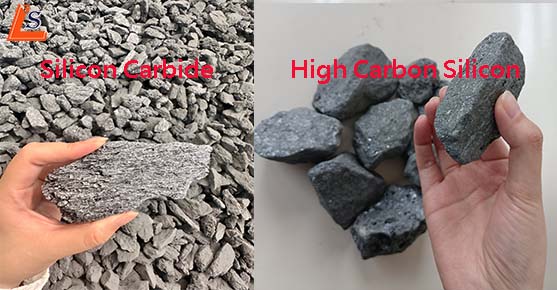
Applications and Advantages of High Carbon Silicon and Silicon Carbide in the Ferroalloy Industry
Understanding these differences shows their distinct positions in the ferroalloy industry.
1. High Carbon Silicon: The "Efficient Assistant" in Steelmaking
The core value of High Carbon Silicon is in steel production. It serves as a functional metallurgical auxiliary material.
?Main Applications:
??Deoxidizer: This is its primary application. In converter or electric furnace steelmaking, it removes oxygen from molten steel. This process reduces alumina inclusions. It also enhances the steel's purity and internal quality.
??Carbon Additive: For some steel grades, High Carbon Silicon provides a stable carbon source.
??Inoculant: In cast iron production, it promotes graphite nucleation. This refines graphite spheres and improves the mechanical properties of castings.
?Advantages:
??Cost-Effectiveness: Compared to pure silicon or ferrosilicon, High Carbon Silicon offers a cost advantage. This helps enterprises control production expenses.
??Process Stability: Its uniform composition and stable reaction lead to a high recovery rate. This contributes to a stable smelting process with fewer fluctuations.
??Improved Steel Quality: Efficient deoxidation reduces harmful impurities in steel. This lays the foundation for producing high-quality steel products.
2. Silicon Carbide: The "Versatile Performer" in High-Temp and Wear-Resistant Fields
Silicon Carbide's direct use in the ferroalloy industry is less extensive than High Carbon Silicon's. Still, its unique properties make it indispensable in supporting sectors.
?Main Applications:
??Refractory Materials: Steelmaking requires high-temperature kilns and ladles. Silicon Carbide is used for furnace linings, ladle bricks, and kiln components. Its high-temperature resistance and corrosion resistance extend equipment service life.
??Abrasives: In steel processing, like grinding and polishing, Silicon Carbide is a common abrasive. It is used in manufacturing grinding wheels and sandpaper to meet surface precision requirements.
?Advantages:
??Extended Equipment Life: As a refractory, its thermal shock and wear resistance are superior to traditional materials. This reduces equipment replacement frequency and maintenance costs.
??Enhanced Processing Efficiency: As an abrasive, its high hardness ensures excellent cutting performance. This improves the efficiency and quality of metalworking.
??High-Temperature Stability: Silicon Carbide maintains its structure in extreme heat. It provides reliable material support for steel production.
Conclusion: Precise Selection to Maximize Value
In summary, High Carbon Silicon and Silicon Carbide play very different roles. High Carbon Silicon is a functional alloy for smelting reactions. Its advantages are in process optimization, steel quality, and cost control. Silicon Carbide is a high-performance material. It ensures stable equipment operation and aids in downstream processing.